
The Cambridge Diet supplies .8 g of calcium per day, in
addition to the nutrients listed in Table 1 for Example 1.
The amounts of calcium per unit (100 g) supplied by the
three ingredients in the Cambridge Diet are as follows: 1.26 g
from nonfat milk, .19 g from soy flour, and .8 g from whey.
Another ingredient in the diet mixture is isolated soy protein,
which provides the following nutrients in each unit: 80 g of
protein, 0 g of carbohydrate, 3.4 g of fat, and .18 g of calcium.
a. Set up a matrix equation whose solution determines the
amounts of nonfat milk, soy flour, whey, and isolated
soy protein necessary to supply the precise amounts of
protein, carbohydrate, fat, and calcium in the Cambridge
Diet. State what the variables in the equation represent.
b. [M] Solve the equation in (a) and discuss your answer.
Passo 1
Beleza pessoal?! Espero que todos estejam bem e dispostos a aprender mais um pouco hoje. A atividade de hoje é uma atividade de mais contextualizada, o que requer nossa atenção total. Vamos nessa!!!
- agora criamos variáveis de x1 a x4 representando as quantidades de leite desnatado através da proteína de soja isolada na Dieta de Cambridge. As unidades desses números são 100 gramas (AKA hectogramas ou décimos de um quilograma). Então formamos o seguinte sistema
- O M é este exercício significa que devemos usar um software de resolução de matrizes. Vou usar o Octave para isso, que é um software gratuito que você pode usar em https://ocateve-online.net/
O sistema equivalente é o seguinte
Passo 2
A sintaxe para inserir uma matriz é usar colchetes do lado de fora, vírgulas para separar números em diferentes colunas e ponto e vírgula para reparar diferentes linhas. Por exemplo, para inserir a matriz de identidade 2 x 2 e nomeá-la como I, nós colocamos.
I = [1, 0; 0, 1]
Para obter a forma escalonada reduzida de uma matriz M, você usa a sntax rref(M)
No Octave nós temos:
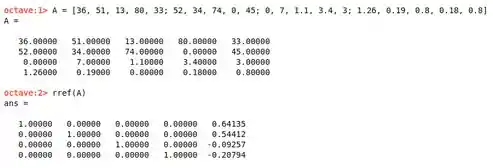
No entanto, vamos olhar para esta solução. É realmente possível termos quantidades negativas de soro de leite e proteína de soja isolada? Não. As pessoas que fizeram a Dieta de Cambridge parecem ter algumas explicações a dar!