
Nos Exercícios 1-4, calcule as derivadas da função nos pontos indicados no gráfico.
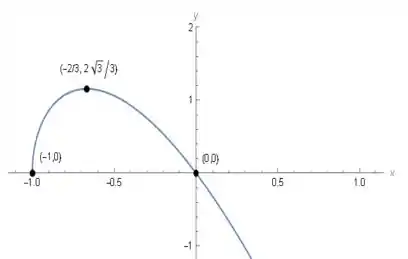
f(x) = -3x * raiz(x + 1)

Passo 1

Podemos notar que f ( x ) = g ( x )   h ( x ) , onde g ( x ) = - 3 x e h ( x ) = x + 1 . Então, pela regra da multiplicação, f ' ( x ) = g ' ( x )   h ( x ) + g ( x )   h ' ( x ) . Calculando as derivadas separadamente, obtemos

g ' ( x ) = - 3 ,

h ' ( x ) = d d x ( x + 1 ) = d d x ( ( x + 1 ) 1 / 2 ) = 1 2 ( x + 1 ) 1 / 2 - 1 = 1 2 ( x + 1 ) - 1 / 2 = 1 2 ( x + 1 ) 1 / 2 .

Agora ficou mais fácil

f ' ( x ) = - 3   x + 1 - 3 x ⋅ 1 2 ( x + 1 ) 1 / 2 = 1 ( x + 1 ) 1 / 2 [ - 3 ⋅ 2   ( x + 1 ) - 3 x ] = - 3 ( 3 x + 2 ) 2 ( x + 1 ) 1 / 2

Passo 2

O próximo passo é calcular a derivada nos pontos ( - 1,0 ) , ( 0,0 ) e ( - 2 / 3,2 3 / 3 ) :

  • x = - 1 . Nesse ponto, temos uma indeterminação. Usando a regra da multiplicação, obtemos:
  • f ' ( - 1 ) = - 3 2 ( l i m x → - 1 ( 3 x + 2 ) ) ( l i m x → - 1 1 ( x + 1 ) 1 / 2 ) = - 3 2 ( 3 ( - 1 ) + 2 ) ) ( l i m x → - 1 1 2 ( x + 1 ) 1 / 2 ) = 3 2 ( l i m x → - 1 1 2 ( x + 1 ) 1 / 2 )

    f ' ( - 1 ) → + ∞

  • x = - 2 / 3
  • f ' ( - 2 / 3 ) = - 3 ( 3 ⋅ ( - 2 / 3 ) + 2 ) 2 ( - 2 / 3 + 1 ) 1 / 2 = - 3 ( - 2 + 2 ) 2 ( 1 / 3 ) 1 / 2 = 0

  • x = 0

f ' ( 0 ) = - 3 ( 3 ⋅ 0 + 2 ) 2 ( 0 + 1 ) 1 / 2 = - 6 2 ( 1 ) 1 / 2 = - 3

Resposta

f ' ( - 1 ) → + ∞

f ' ( - 2 / 3 ) = 0

f ' ( 0 ) = - 3